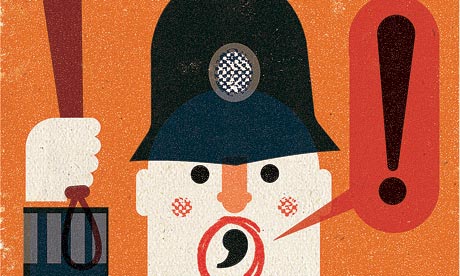
'The debate about how far language ought to be allowed to evolve is an old one.' Illustration: Adam Howling for the Guardian

Why do they adopt an error-hunting mindset?

Why do they adopt an error-hunting mindset?

‘The debate about how far language ought to be allowed to evolve is an old one.’ Illustration: Adam Howling for the Guardian

Think of the word “atrocity”, and certain appalling behaviours spring to mind. Add “barbaric”, and the picture gets worse. How about a barbaric atrocity that’s “detestable” and provokes “horror”? At this point, it’s surely time for a UN intervention. We must act to halt this outrage! Except that all the words just quoted come from discussions of the uses and abuses of English. Simon Heffer, in his recent book Strictly English, thinks the so-called “greengrocer’s apostrophe” is an atrocity, and that academics write barbarically; William Zinsser’s guidebook On Writing Well also condemns some usages as atrocities, and others as detestable. Meanwhile, contributors to a BBC debate on Americanisms earlier this year spoke of their “horror” and “hate” in reaction to phrases that made them “feel the rage rising”. The debate about how far language ought to be allowed to evolve is an old one. But all this fury raises a more specific psychological question: what are people so angry about?

To follow the Legislature, you need the lingo

The Washington State Capitol. Taken from The J...

Image via Wikipedia

To follow the Legislature, you need the lingo

PETER CALLAGHAN; STAFF WRITER

Published: 01/05/12 12:05 am


Like any other professional group or secret society, the Washington Legislature has its own terminology.

Knowing the lingo, therefore, is the first step toward breaking into the power structure. As a public service, here are some of the most-used and least-understood terms that lawmakers, staff members and lobbyists will use during the second regular session of the 62nd Legislature that convenes in Olympia Monday.

The Language of Lies

The Language of Lies

Posted: 1/5/12 12:08 AM ET


It turns out to be difficult to tell when other people are lying. There are lots of cues that we believe will tip us off to whether someone is telling the truth. We expect people telling the truth to be more confident, to look us in the eye when they talk, and to speak more fluently. But, these cues aren’t really reliable indicators of truth telling. Someone might be uncomfortable talking about a topic and look away from you, yet still be telling you the absolute truth.

A nice set of studies by Tom Gilovich, Kenneth Savitsky, and Victoria Medvec in the Journal of Personality and Social Psychology in 1998 made this point. They had people answer questions about themselves to a group. Some people were asked to tell the truth, while other people were told to lie. Afterward, the speakers who lied were asked to rate how many people in the room would think they were lying, while those in the audience rated each speaker for whether they were telling the truth or lying. Speakers who were told to lie strongly overestimated how many people would know they were lying. They felt as though the evidence for the lie was leaking out of them, even though the audience actually had a hard time determining who was lying and who was telling the truth.