
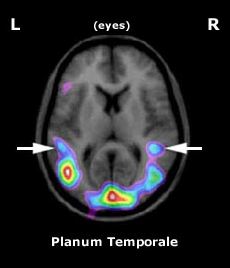
planum

Brain Wiring for Human Language, Scientific American 6/12/2000

By Kristin Leutwyler

Source: LAURA ANN PETITTO

Scientists have long been interested how the deaf process signed languages in the brain. Understanding that activity could shed light on whether the brain harbors specialized structures for decoding linguistic patterns in general¿regardless of how they are conveyed. In fact, a new study published in Tuesday’s issue of the Proceedings of the National Academy of Science suggests that the brain does have such wiring, challenging the idea that speech and sound are vital for human language. Laura Ann Petitto and Robert Zatorre of McGill University and their colleagues base their conclusions on a series of experiments using positron emission tomography (PET) brain scans of 11 profoundly deaf people and 10 hearing people.

Stretching Your Mouth Affects What You Hear, Scientific American 28/5/2009

Depending on how a mechanical device pulls and tugs areas around the mouth, the volunteer will hear and interpret speech sounds differently

By Erica Westly

Neuroscience textbooks typically portray the five senses as separate entities, but in the real world the senses frequently interact, as anyone who has tried to enjoy dinner with a stuffy nose can attest. Hearing and vision seem similarly connected, the most famous example being the “McGurk effect,” where visual cues, such as moving lips, affect how people hear speech. And now new research shows that touch can influence speech perception, too.

How America got its name, Boston Globe, 4/7/2010


The suprising story of an obscure scholar, an adventurer’s letter, and a pun

Each July 4, as we celebrate the origins of America, we look back ritually at what happened in 1776: the war, the politics, the principles that defined our nation.

But what about the other thing that defines America: the name itself? Its story is far older and far less often told, and still offers some revealing surprises.

1559 Genève se met à l’étude du grec, Tribune de Genève 2/7/2010

La scène est célèbre. Elle se situe à l’acte III desFemmes savantes,le brûlot écrit par Molière en 1672 (et en alexandrins) contre l’instruction des dames et demoiselles. Un homme «vêtu de noir et parlant d’un ton doux» se voit admis au gynécée (tiens, un mot grec!).

Trissotin:«Il a des vieux auteurs la pleine intelligence/Et sait du grec, Madame, autant qu’homme en France. »
Philaminte:«Du grec, ô Ciel, du grec! Il sait du grec, ma sœur!»
Bélise:«Ah, ma nièce, du grec!»
Armande:«Du grec! Quelle douceur!»
Philaminte:«Quoi, Monsieur sait du grec! Ah permettez de grâce/Que pour l’amour du grec, Monsieur, on vous embrasse. »